Founding Marketing
Marketing is a derivative of your company strategy. If the company strategy is unclear, your marketing will be confused. If your long term vision is sharp, every campaign, every message, every piece of content becomes a step toward that future. Marketing requires founder-level thinking. Marketing decisions are company decisions in disguise.
If your company strategy is weak, no amount of marketing will save you. Fix the strategy first. Marketing amplifies direction.
Two jobs to be done
Marketing has two jobs. Tell the right people the right story, and make sure they actually hear it. Everything else is overhead. So it has two parts: communication and distribution. What you say, and how you get it in front of the right people. Neither lives in a silo. Marketing touches product, sales, and everything in between.
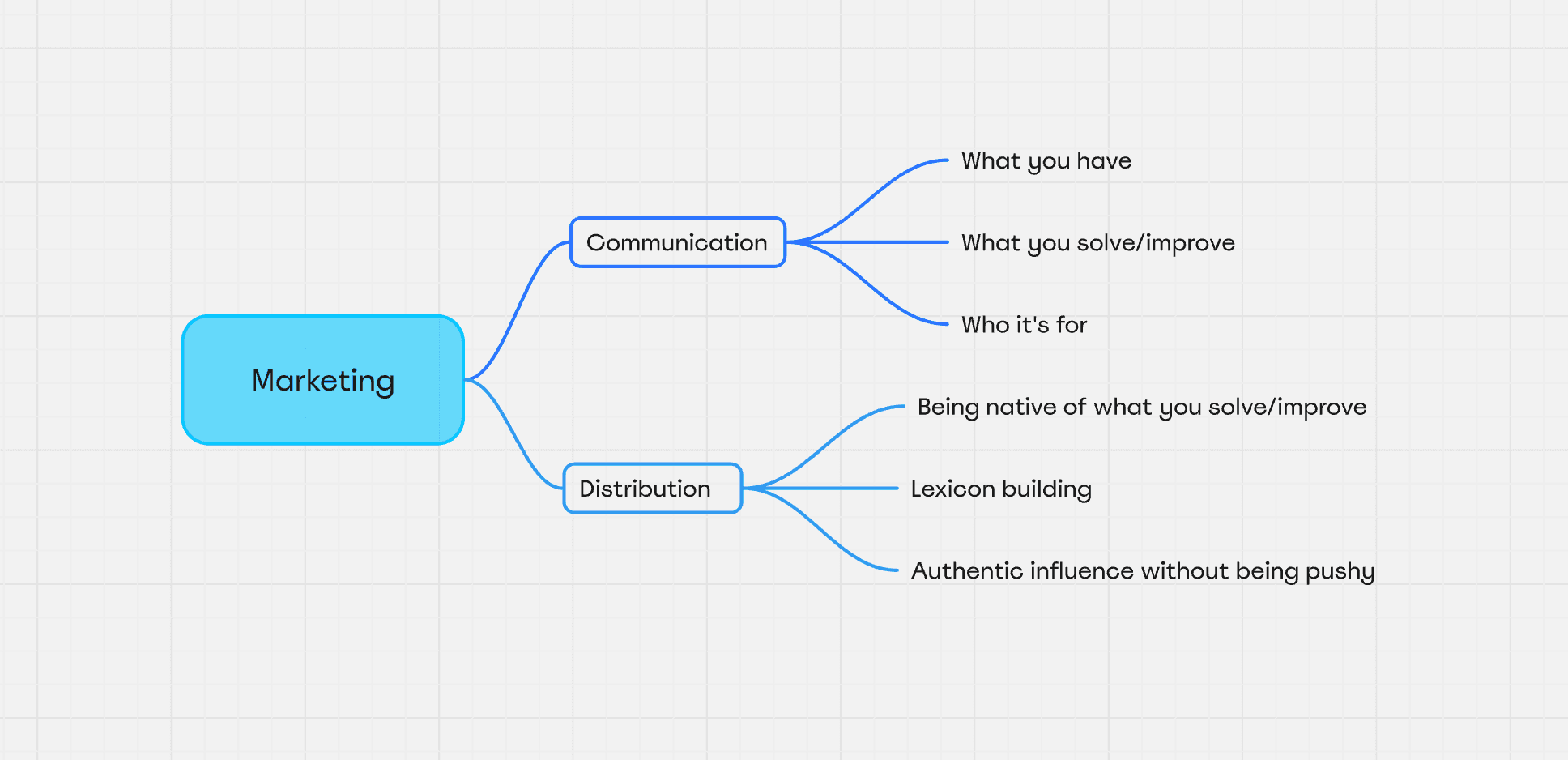
Marketing framework: strategy -> communication -> distribution
Communication
Communication starts with what you have, what you plan to have, and who this is for. Answer these and you have a marketing plan.
The core of it is what powers does your product give people to make something better.
You should know:
- What your product is
- What type of people your product is improving conditions for
- What your product improves for them
- How they describe the problem you're solving
That last point is where most marketing fails. You can nail the first three and still miss because you're describing the problem in your words, not theirs. Understanding how your audience talks about their pain is the difference between marketing that resonates and marketing that gets ignored.
If you asked me what the most problematic audience definitions to kickstart marketing are, I'd list:
- My audience is everyone
- All people living in the USA
- All small business owners
If you can't name specific people who have the problem you solve, you don't have an audience, you have a hope.
Communication flow: product -> audience -> problem -> their language
Distribution
Distribution is where you find out if you're right.
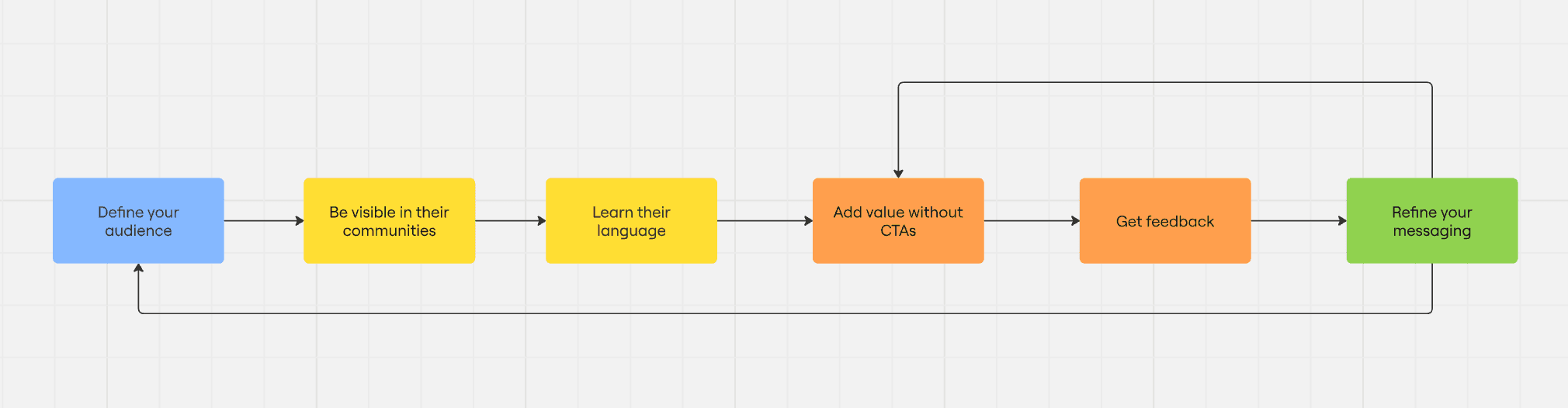
Define your audience -> be visible to them with a clear message -> get feedback -> iterate your message
Distribution starts with understanding how your audience describes the areas you exist to improve for them. Speaking their language and understanding how they describe your product is the shortest way to grow the company. Specific words and specific terms are crucial.
Every industry, community, and customer segment has linguistic patterns that signal belonging. When you notice language patterns your competitors miss, you've found gold. These phrases reveal deeply held beliefs, values, and pain points that marketing surveys will never uncover.
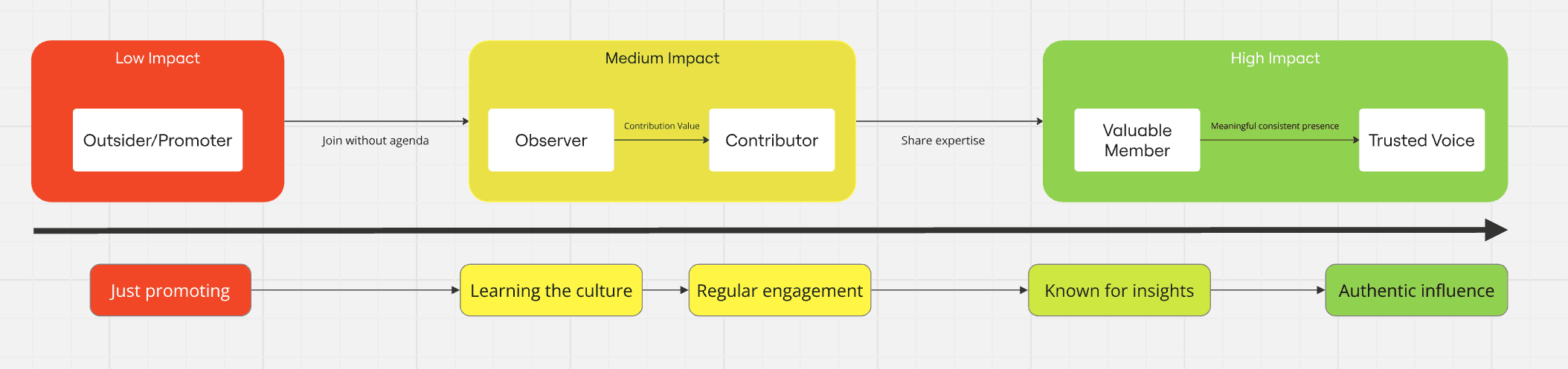
The best promotion comes from a native community member that everyone can learn something from. Being visible should not be measured by numbers. You can't easily measure influence. Marketing without CTAs is the best long-term marketing tactic.
Distribution cycle: define audience -> be visible -> get feedback -> iterate
Before sharing anything about your product, become a native member of the communities where your audience hangs out. If your product is a to-do app, be one of the most active people in productivity communities. Be a community member first, not someone asking weird questions about areas where your product excels.
The early authentic relationships you build won't scale, and that's exactly the point. Do things by hand that don't scale first, then systematize only after you've learned what works. Join the communities, answer questions personally, follow up individually. This seems inefficient, but it creates the foundation for word-of-mouth growth that no ad budget can buy. Once you understand exactly what resonates, then you can think about automation and scale.
Everyone loves numbers. But most marketing metrics are noise for early-stage products. Pick one metric that matters for your specific stage.
If you're pre-product-market fit, focus on weekly retention. If you're scaling, focus on customer acquisition cost. Whatever it is, rally your entire team around this number. When engineers and marketers track the same metric, they start speaking the same language.